Case Study - Building an AI-Enabled Platform for Accessible Contraceptive Care
A mission-driven healthcare organization set out to create a digital platform that would make trustworthy birth control information and care pathways easier to access.
- Client
- National Reproductive Healthcare Organization
- Year
- Services
- Fractional CTO Leadership, AI Strategy, Product Architecture, Healthcare Platform Development
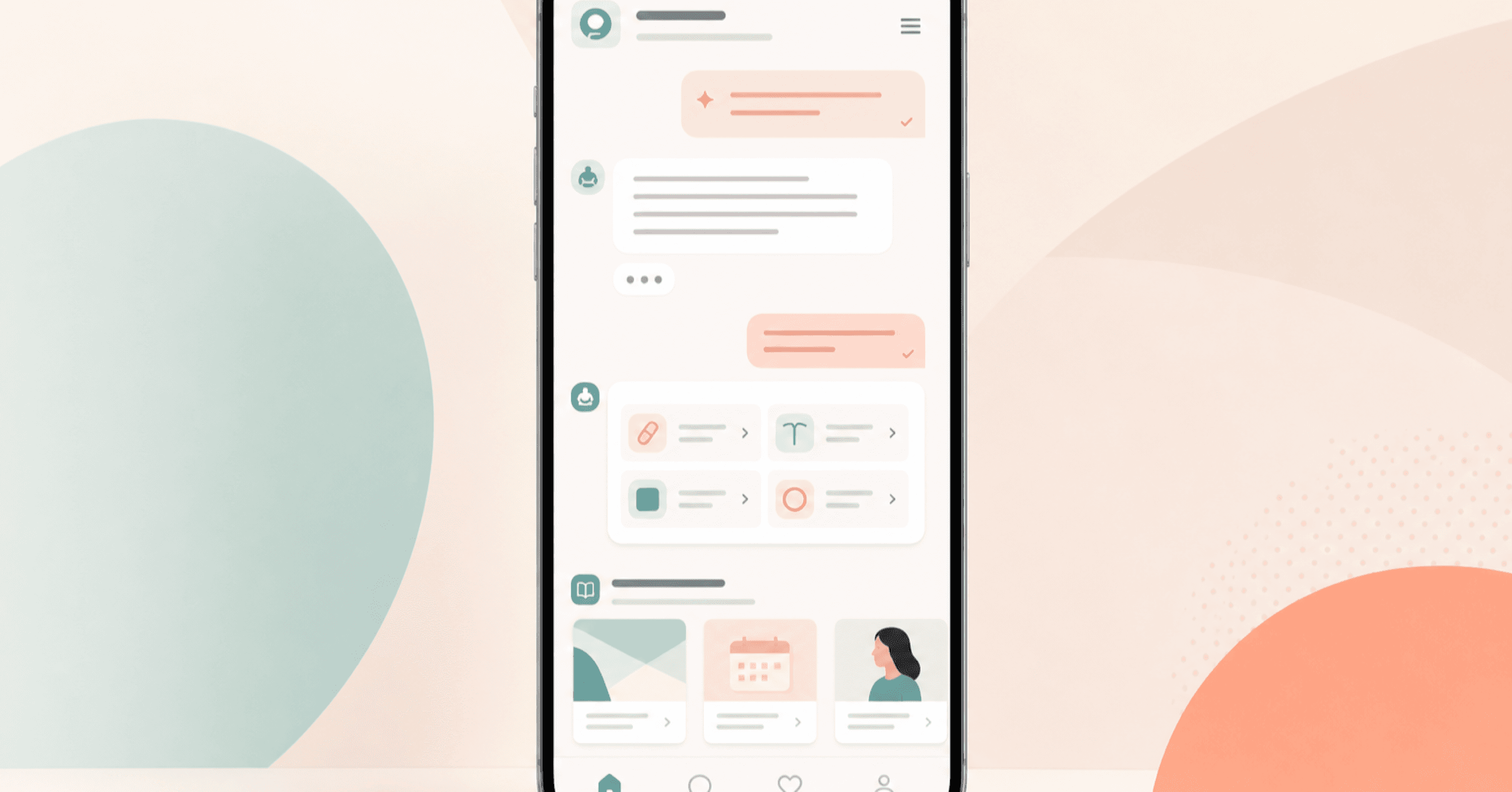
A mission-driven healthcare organization set out to create a digital platform that would make trustworthy birth control information and care pathways easier to access.
The vision went well beyond launching a new website. The organization needed a secure, scalable platform that could support conversational AI, educational content, guided decision-making tools, human support, and future telehealth partnerships—all while protecting sensitive health information and operating within responsible clinical boundaries.
As fractional CTO, I helped translate that vision into a practical product and technology strategy and guided the platform from early planning through implementation.
The Challenge
People looking for birth control information often face more than a lack of medical knowledge. Cost, transportation, limited provider availability, privacy concerns, and uncertainty about available options can all make accessing care more difficult.
The organization wanted to reduce those barriers by creating an experience where users could learn about contraception, explore their preferences, ask questions conversationally, and connect with additional support when needed.
The platform also needed to serve a wide range of users, many of whom would access it primarily from a mobile device and may have limited familiarity with healthcare terminology.
From a technical perspective, the challenge was equally complex. The platform needed to support AI without allowing it to diagnose, prescribe, or replace a licensed healthcare professional. It needed to handle potentially sensitive information responsibly, integrate with external care providers, and remain flexible enough to support future programs, partners, and branded experiences.
The immediate goal was to launch an effective first version without making architectural decisions that would limit the organization later.
Turning the Vision Into a Platform Strategy
The first step was converting a broad healthcare and social-impact vision into a clear product and technology roadmap.
I worked closely with organizational leadership, product stakeholders, clinicians, designers, engineers, and external vendors to define what needed to be included in the initial release and what should be developed over time.
This included shaping the platform's product model, evaluating technology vendors, clarifying build-versus-buy decisions, and identifying privacy, security, operational, and integration risks before they became expensive problems.
The result was a phased strategy that allowed the organization to move forward quickly while preserving a foundation for future growth.
Designing a More Approachable Healthcare Experience
The platform was designed around the reality that many users would arrive with questions rather than a clear understanding of what service or birth control option they needed.
Instead of forcing users through a rigid clinical workflow, the experience combines educational content, guided questions, conversational assistance, and clear paths to human support.
Users can explore birth control options in plain language, learn about common considerations, and receive help navigating the next step. The experience is mobile-first, responsive, and structured so it can eventually support additional languages and culturally relevant content.
The goal was not simply to present healthcare information, but to make it feel easier to understand and less intimidating to act on.
Experience layer
Education · Guided tools · AI companion · Human support
Platform layer
Applications · APIs · Admin tools · Analytics
Foundation layer
AWS cloud · Security · Data · Partner integrations
Building a Responsible AI Companion
A core part of the platform is an AI-powered companion that helps users understand contraceptive information and navigate the experience conversationally.
Healthcare AI introduces different risks than a typical customer-service chatbot. The system needed to be useful without creating the impression that it was practicing medicine.
To support that distinction, the AI experience was designed around a curated knowledge foundation, structured prompts, explicit safety boundaries, and clear escalation paths. It helps users understand general information, compare considerations, and formulate better questions, but it does not diagnose conditions, prescribe medication, or make clinical decisions.
The architecture also includes controls for conversation length, system usage, unexpected behavior, and service reliability. Voice capabilities were introduced to make the experience more accessible to users who may prefer listening or speaking instead of reading and typing.
The AI serves as a guide into care—not a substitute for care.
Establishing a Secure Healthcare Foundation
Because the platform operates in a sensitive healthcare context, security and privacy had to be built into the architecture from the beginning.
I helped design a cloud environment with separated application, data, storage, and administrative components. Data is protected in transit and at rest, internal tools require controlled access, and monitoring is in place across infrastructure and critical user journeys.
The platform also follows a data-minimization approach. Rather than collecting information simply because it may be useful later, the system is designed to limit collection and exposure to what is necessary for the user experience and service being provided.
Administrative access, analytics, external vendors, transactional communications, and third-party integrations were all evaluated through that same lens.
This created a security and compliance posture appropriate for a growing healthcare organization without introducing unnecessary enterprise complexity or cost.
Preparing for Healthcare Partnerships
The organization's long-term vision extends beyond a single consumer-facing platform.
The underlying architecture was designed so its educational content, AI capabilities, and guided experiences could eventually be distributed through healthcare providers, community organizations, and other partners.
That required thinking early about configurable experiences, co-branding, partner attribution, secure APIs, referral workflows, and how to separate educational interactions from clinical and identifying information.
Partner flexibility was treated as an architectural requirement—not a future add-on.
By building for distribution from the start, the organization can expand its reach without rebuilding the platform for each new relationship.
Providing Ongoing Technical Leadership
Fractional CTO role
My role extended beyond defining the initial architecture. As fractional CTO, I provided ongoing leadership across product planning, engineering execution, infrastructure, security, testing, analytics, vendor selection, and production readiness.
I worked with the team to establish development and release practices, introduce automated testing, improve monitoring, review architectural decisions, and resolve production issues. I also helped coordinate decisions across leadership, clinicians, designers, engineers, contractors, and technology vendors.
This gave the organization consistent senior technical leadership while allowing it to build a team and operating model suited to its stage and nonprofit budget.
The Result
The engagement created the foundation for a scalable healthcare platform that brings together education, conversational AI, user guidance, human support, and external care pathways in one cohesive experience.
The organization now has a clearer product and technology roadmap, a production-oriented AI model with healthcare-specific safeguards, and a secure cloud architecture that can support additional services and partnerships over time.
It also has stronger engineering practices around testing, monitoring, administrative access, analytics governance, and release management.
Most importantly, the platform makes complex reproductive healthcare information easier to approach. It helps users better understand their options and move toward appropriate support while maintaining clear boundaries between education, technology, and clinical care.
Technology Foundation
The platform was built using React, TypeScript, Node.js, Fastify, PostgreSQL, and AWS cloud infrastructure.
Its AI capabilities use Anthropic Claude, supported by structured prompting, curated healthcare knowledge, safety controls, and usage monitoring. Azure AI Speech supports voice accessibility, while PostHog provides privacy-conscious product analytics.
The broader technical foundation includes containerized infrastructure, infrastructure as code, automated end-to-end testing, cloud monitoring, audit logging, application security controls, transactional email, content-management capabilities, and healthcare partner integrations.
Summary
This project required more than application development.
It required aligning healthcare strategy, social impact, user experience, AI safety, privacy, cloud architecture, vendor decisions, and engineering execution around a single platform vision.
By combining executive-level technical leadership with hands-on architectural guidance, I helped the organization move from an ambitious concept toward a secure and scalable healthcare AI platform designed to make contraceptive information and care pathways more accessible.
Related service: Fractional CTO